

A hydraulic bottle jack is designed to lift heavy loads by converting hydraulic pressure into lifting force. Because the tool may be used to raise vehicles, machinery, and other substantial loads, controlling hydraulic pressure is just as important as generating it.
This is where a safety valve becomes an important part of the hydraulic system. A properly designed safety or bypass valve can help prevent excessive pressure from placing unnecessary stress on the jack when the applied load reaches or exceeds its rated capacity.
For automotive repair shops, equipment distributors, and professional users, understanding how this feature works can make it easier to evaluate a hydraulic bottle jack beyond its lifting capacity alone.
What Does a Safety Valve Do in a Hydraulic Bottle Jack?
A safety valve is essentially a pressure-control mechanism within the hydraulic system. During normal operation, hydraulic fluid is directed into the cylinder to create the pressure needed to raise the ram. As the load increases, the pressure inside the system also increases.
If the applied load becomes excessive, hydraulic pressure can rise beyond the level the system is designed to handle. A safety bypass valve is intended to limit this excessive pressure by allowing hydraulic fluid to bypass the normal lifting circuit rather than continuing to increase pressure.
In practical terms, this means that when the jack reaches its designed pressure limit, repeatedly pumping the handle should not simply force the hydraulic system to generate unlimited pressure.
This type of overload protection is also reflected in established jack safety requirements. For example, OSHA requires jacks to have their rated capacity clearly marked and states that the rated capacity must not be exceeded.
The safety valve therefore should not be viewed as a substitute for correct jack selection. Instead, it functions as an additional protective mechanism within a properly rated lifting system.
Why Is Overload Protection Important?
The rated capacity of a hydraulic bottle jack represents the load for which the equipment is designed. Choosing a jack with insufficient capacity can create excessive hydraulic and mechanical stress.
For example, an operator may know that a vehicle weighs approximately 3 tons but select a jack with a capacity that is too close to the expected load. The actual load at the lifting point can vary depending on how the vehicle is positioned and where the jack is placed.
Excessive pressure can potentially affect seals, hydraulic components, the cylinder, and other structural parts. A damaged hydraulic system may also develop leakage or lose its ability to maintain lifting performance.
A safety valve provides another layer of protection by limiting pressure within the hydraulic circuit. Manufacturers of professional hydraulic bottle jacks commonly incorporate overload or bypass systems for this reason. Some commercial bottle jacks, for example, specifically describe their safety valves as fluid bypass systems intended to prevent overloading and damage to the jack.
However, a safety valve does not make an overloaded jack safe to use. The correct approach is still to select a jack with an appropriate rated capacity and operate it according to the manufacturer's instructions.
How Does a Safety Valve Work?
The basic principle is relatively straightforward.
When the operator pumps the handle, hydraulic fluid moves from the reservoir into the lifting cylinder. This creates hydraulic pressure, which pushes the ram upward and raises the load.
Under normal conditions, the hydraulic pressure remains within the operating range of the jack. When pressure approaches the predetermined limit of the safety mechanism, the bypass function can redirect fluid rather than allowing pressure to continue rising indefinitely.
This is why an overload-protected hydraulic bottle jack may stop lifting when the applied load is beyond its intended capacity instead of continuing to build pressure.
The exact valve design, pressure setting, and hydraulic circuit vary between manufacturers and models. For this reason, buyers should check the manufacturer's technical specifications rather than assuming that every hydraulic bottle jack uses the same type of safety valve.
Does a Safety Valve Make a Hydraulic Bottle Jack Safer?
It can improve the jack's protection against excessive hydraulic pressure, but it is only one part of safe lifting.
A safe lifting operation also depends on the jack's rated capacity, structural design, condition, operating surface, load position, and correct use. OSHA guidance, for example, requires the jack to have a sufficient rated capacity and states that a raised load should be secured or supported after lifting.
This distinction is important in automotive repair. A hydraulic bottle jack is primarily a lifting device. It should not automatically be treated as the sole support for a vehicle while a person works underneath it.
For workshop applications, the jack should be positioned correctly on a suitable lifting point and used together with appropriate support equipment when required.
What Should Buyers Look for in a Hydraulic Bottle Jack?
When purchasing hydraulic bottle jacks for a workshop, dealership, tool distribution business, or aftermarket automotive market, lifting capacity is only one specification worth examining.
A MORE COMPLETE EVALUATION SHOULD CONSIDER:
For distributors and OEM buyers, consistency between batches can be particularly important. A safety feature is valuable only when the valve, hydraulic components, and overall jack construction are manufactured to the required specifications.
Hydraulic Bottle Jack with Safety Valve for Automotive Applications
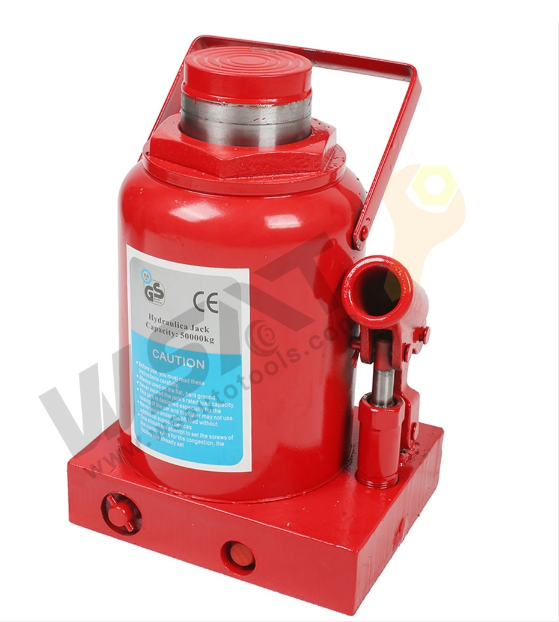
For automotive repair, a bottle jack with an integrated safety bypass valve can be a practical choice when compact lifting equipment with different capacity options is required.
For example, Winsen's Hydraulic Bottle Jack with Safety Valve is offered in capacities from 2 to 50 tons, covering a relatively broad range of lifting requirements. The product uses a safety bypass valve designed to prevent overloading and is positioned for both residential and commercial applications.
The available models also cover different minimum and maximum lifting heights, allowing buyers to select a configuration according to the vehicle or equipment being serviced.
THE LISTED RANGE INCLUDES:
For a buyer, the advantage of having several capacity options is that the jack can be selected according to the actual application rather than treating one capacity as suitable for every vehicle.
Safety Valve vs. Correct Jack Selection
It is easy to overestimate the role of a safety valve. The valve is an important protective component, but it should never be used as justification for selecting a jack that is too small for the intended load.
A better purchasing approach is to start with the required lifting capacity and working height, then evaluate the safety system and construction quality.
For example, if a workshop regularly services passenger vehicles, SUVs, commercial vehicles, or heavier equipment, its jack requirements may differ considerably. A compact jack may be convenient for certain automotive applications, while heavier-duty equipment may require substantially higher capacity.
The safety valve should therefore be considered part of the overall safety design rather than the only safety feature that matters.
How to Maintain the Safety Performance of a Hydraulic Bottle Jack
Even a well-designed safety valve cannot compensate for poor maintenance. Hydraulic jacks should be inspected according to their service conditions, and damaged or malfunctioning equipment should not remain in operation.
OSHA recommends regular inspection, lubrication, examination of replacement parts, and removal from service when a jack is not in proper working condition. Jacks subjected to abnormal loads or shock should receive particular attention.
For professional workshops, routine inspection can help identify issues such as hydraulic leakage, damaged components, abnormal lowering, or other changes in lifting performance before the equipment is placed under a significant load.
A Small Component with an Important Role
A safety valve may be a relatively small component inside a hydraulic bottle jack, but its function is closely connected to pressure control and overload protection.
The most important point is that safe lifting does not depend on the valve alone. A suitable rated capacity, stable positioning, sound hydraulic components, proper maintenance, and appropriate supporting equipment all contribute to a safer lifting operation.
For buyers comparing hydraulic bottle jacks, therefore, the presence and design of a safety valve are worth examining alongside capacity, lifting range, construction quality, and manufacturer reliability. A well-designed hydraulic bottle jack with safety valve can provide an additional layer of protection while giving workshops and equipment distributors more flexibility when selecting lifting equipment for different applications.