

Whether you are maintaining industrial machinery, testing electric motors, or calibrating production equipment, accurate rotational speed measurement is essential. A digital tachometer is the instrument of choice for engineers, technicians, and quality control professionals worldwide — delivering precise RPM readings quickly, reliably, and with minimal user error. This guide covers everything you need to know about digital tachometers, from fundamental operating principles to real-world applications, and introduces three purpose-built solutions from Winsen, a trusted name in precision sensing technology.
What is a Digital Tachometer?
A digital tachometer (also referred to as a digital RPM meter or digital rev counter) is an electronic instrument used to measure the rotational speed of a shaft, disk, wheel, or any other rotating component. Speed is expressed in revolutions per minute (RPM), and readings are displayed on an LCD or LED screen for instant, unambiguous interpretation. Using electronic sensors to detect rotational events (pulses) and microcontroller-based signal processing to convert them into RPM values, digital tachometers offer superior accuracy, faster response times, and the ability to capture transient speed changes that analog instruments would miss entirely.
When evaluating any digital tachometer, the following specifications matter most: measurement range (the minimum and maximum RPM the instrument can reliably detect), accuracy (typically expressed as a percentage of reading), resolution (the smallest increment of speed the instrument can distinguish), and sampling frequency (how often the display is updated).
Types of Digital Tachometers
Digital tachometers are broadly categorized based on their sensing method. Each type is suited to different access conditions and application environments.
Contact-Type
Contact-type tachometers measure speed by placing a rotating probe tip directly against the surface of the moving object. They are well-suited for accessible shafts, rollers, and low-to-moderate-speed equipment where physical contact is safe and practical.
Non-Contact
Non-contact tachometers use a laser beam directed at a strip of reflective tape adhered to the rotating surface. Each pass of the tape generates a detectable pulse, allowing RPM to be calculated from a safe distance without touching the equipment at all. This makes them ideal for high-speed or guarded machinery where contact would be hazardous.
Optical
Optical tachometers operate on a similar non-contact principle, using a focused light source and photodetector to sense rotation. Many professional instruments combine both contact and optical modes in a single unit, giving technicians the flexibility to choose the most appropriate method for each job.
Winsen Digital Tachometers — Precision Engineered for Every Application
Winsen (Zhengzhou Winsen Electronics Technology Co., Ltd.) has been a leading developer and manufacturer of sensing instruments since the 1990s, holding certifications including ISO9001, ISO14001, IATF16949, and CE. With over 30 years of sensing expertise, Winsen offers three purpose-built digital tachometer models designed to cover the full spectrum of rotational speed measurement needs.
Winsen Digital Tachometer — Reliable Contact Measurement for Everyday Use
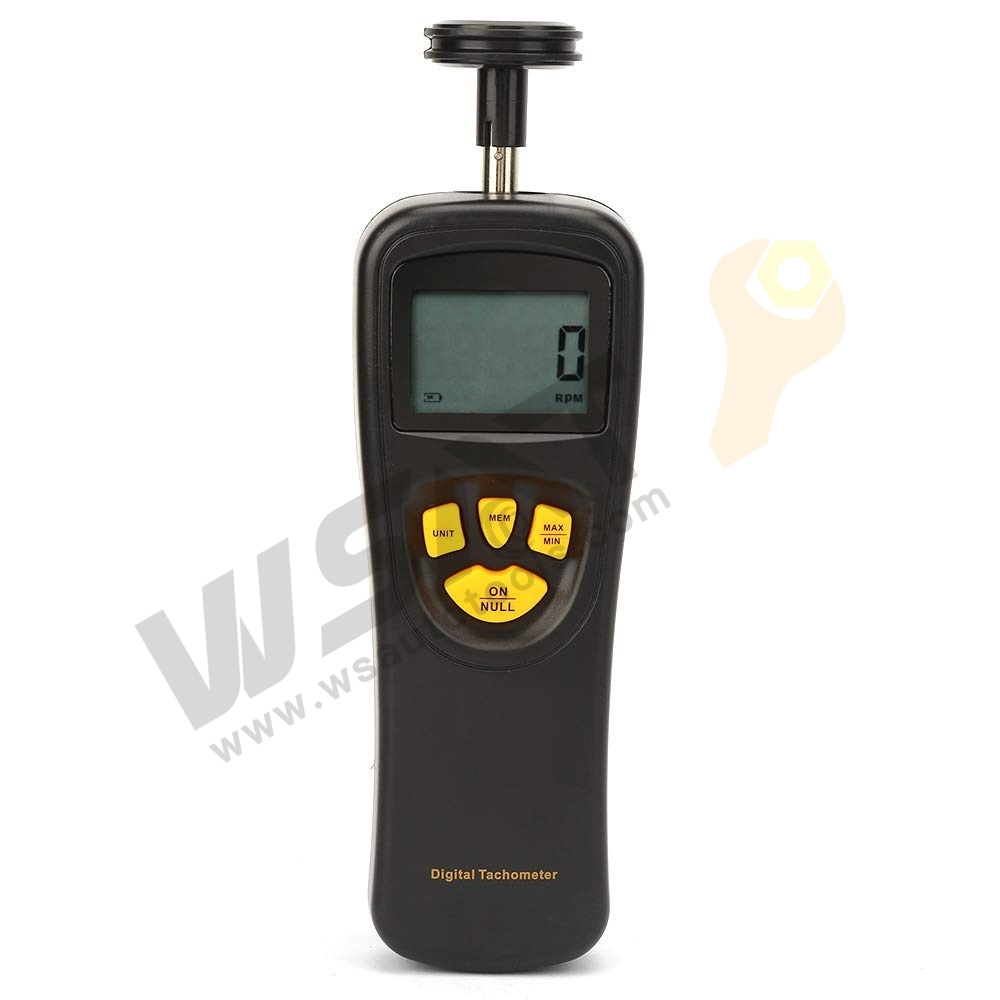
The Winsen Digital Tachometer applies MCU and electro-optical technology to perform efficient contact measurement of both rotating and linear rolling speed. With a measuring range of 0.5–19,999 RPM, a resolution of 0.1 RPM, and an accuracy of ±(0.05% + 1 digit), it delivers professional-grade precision for a broad range of industrial tasks. The large LCD display ensures clear readings at a glance, while interchangeable accessories accommodate different shaft and roller sizes. Like all Winsen tachometers, it automatically stores the Maximum, Minimum, and Last measured values — a practical feature that saves time during inspection rounds.
Ideal For: Routine motor speed verification, conveyor and production line monitoring, HVAC fan inspection, and general preventive maintenance.
Winsen Non-Contact Digital Tachometer — Instant Laser Measurement, Anywhere
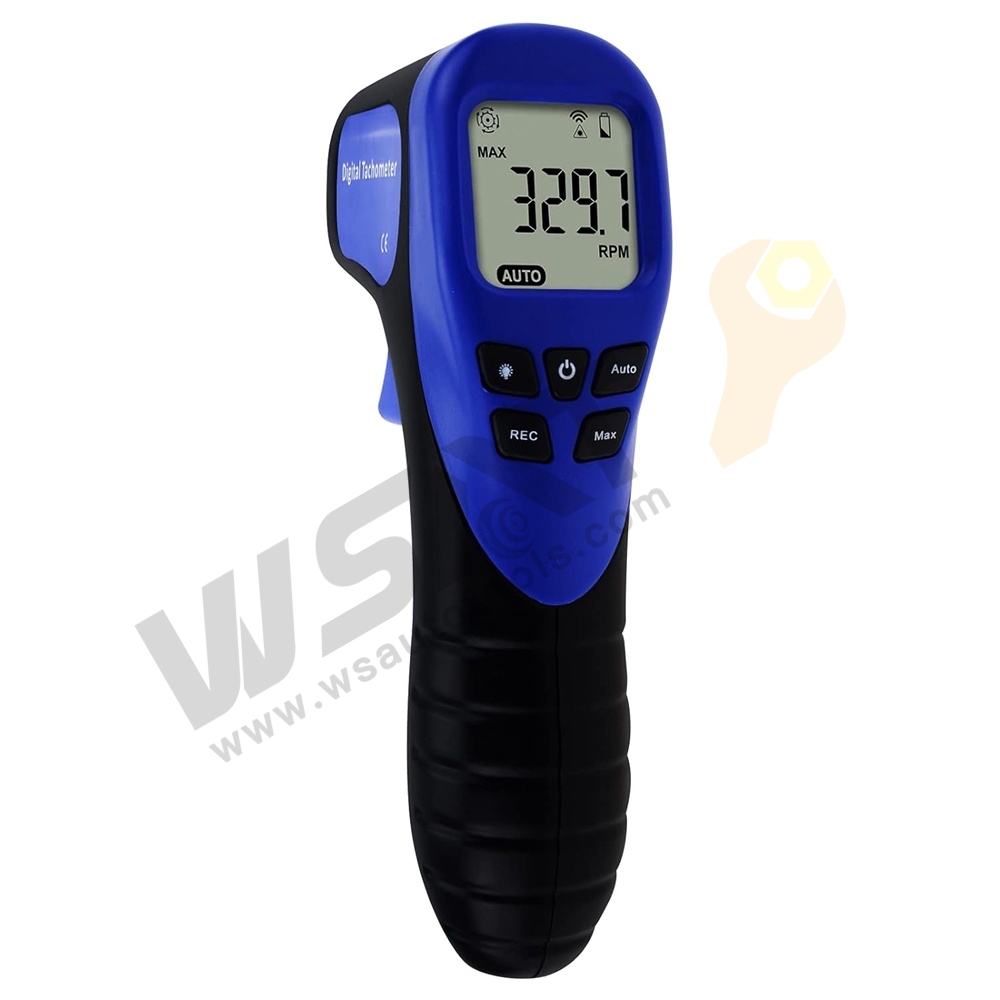
The Winsen Non-Contact Digital Tachometer is built for speed and simplicity. Point the instrument at the target, activate the laser, and read the result — no probe contact, no complex setup. It achieves an exceptional accuracy of ±0.02% + 1 digit, making it one of the most precise handheld non-contact tachometers in its class. The backlit LCD ensures readability in low-light environments, and both auto and manual power-off modes help extend battery life in the field. Each unit ships ready to use, complete with a 9V battery, carry pouch, and reflective tape.
Note: Reflective tape must be applied to the target surface before measuring. Avoid directing the laser toward eyes, and do not operate in potentially explosive environments.
Ideal For: High-speed spindle and motor RPM verification, testing guarded or inaccessible rotating equipment, and any application requiring safe stand-off measurement.
Winsen Contact and Optical Type Digital Tachometer — Maximum Versatility in One Instrument
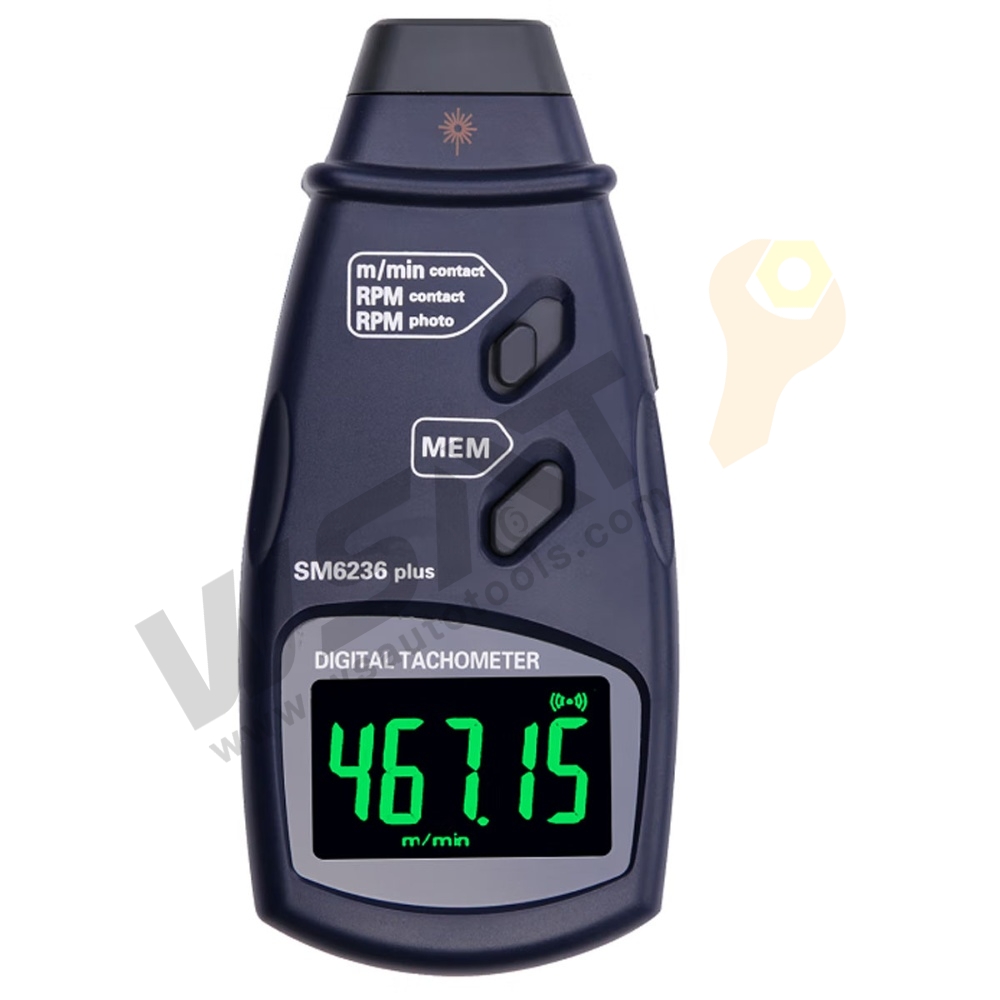
For technicians who need one instrument to handle every scenario, the Winsen Contact and Optical Type Digital Tachometer delivers both contact and photoelectric measurement modes, switchable at any time. It covers an impressive range of 2.5–99,999 RPM with an accuracy of ±(0.05% + 1 digit), and its 5-digit, 18 mm LCD provides outstanding clarity. A standout feature is the pre-storage function, which can hold up to 96 consecutive measurement values — ideal for data collection tasks where trends and consistency matter. Built on MCU technology with anti-interference circuitry, it performs reliably even in electrically noisy industrial environments. The grooved speed-limiting accessories further extend its utility to linear speed measurement of wire, cable, and rope.
Ideal For: Field service engineers working across mixed equipment types, quality assurance labs, cable and wire production monitoring, and applications requiring both contact and non-contact capability.
Industry Applications
Digital tachometers are indispensable across a broad range of industries. In manufacturing and production, they verify conveyor speeds, validate CNC spindle RPM, and support process quality control without interrupting live operations. In automotive engineering, they provide ground-truth speed data for engine testing and powertrain calibration on dynamometer benches. HVAC service engineers rely on non-contact tachometers to confirm fan and blower speeds during commissioning, ensuring systems meet rated airflow performance. In energy and power generation, non-contact models are essential for measuring turbine auxiliary shafts and generator drives in restricted-access locations. Research and development laboratories favor high-resolution optical tachometers for characterizing motors, validating test rigs, and verifying centrifuge and instrument speed consistency.
How to Choose the Right Digital Tachometer
Selecting the right tachometer comes down to a few key considerations.
Access and safety should be your first filter: if the rotating surface is safely accessible and moving at moderate speed, a contact-type instrument is accurate and straightforward. If the equipment is guarded, high-speed, or otherwise hazardous to approach, a non-contact or optical model is the correct choice.
Measurement range must comfortably encompass your target speed. Most industrial motors operate between 300 and 3,600 RPM, while high-speed spindles may exceed 20,000 RPM — the Winsen Contact and Optical Type covers up to 99,999 RPM for the most demanding applications.
Data requirements matter for professional use. If you need to capture transient speed peaks or log multiple consecutive readings, choose an instrument with robust memory functions. The Winsen Contact and Optical Type Tachometer's 96-value pre-storage capability is particularly valuable for data-driven maintenance and quality reporting.
| Application Scenario | Recommended Winsen Tachometer |
|---|---|
| Routine motor and shaft speed checks | Digital Tachometer |
| High-speed or guarded rotating equipment | Non-Contact Digital Tachometer |
| Multi-mode field service or mixed applications | Contact and Optical Type Digital Tachometer |
Conclusion
Accurate rotational speed measurement is a foundation of reliable equipment maintenance, process quality, and engineering integrity. Winsen's range of digital tachometers — from the straightforward Digital Tachometer to the laser-equipped Non-Contact model and the advanced dual-mode Contact and Optical Type — reflects decades of precision sensing expertise and a deep understanding of real-world industrial demands. Each instrument is built to the same rigorous quality standards that have made Winsen a trusted sensing partner for customers across more than 100 countries.
If you are looking for a dependable, professionally engineered tachometer solution, contact Winsen today to speak with a product specialist or request a sample.
Contact Winsen →